




Cable glands are essential components in industrial electrical systems. They are used to secure, seal and protect cables while maintaining reliable electrical connections in demanding environments.
Choosing the right cable gland helps ensure equipment safety, system reliability and long-term performance. With a wide range of materials, thread types and protection ratings available, selecting the best option depends on the application and operating conditions.
This guide outlines the main types of cable glands and their typical applications, helping you choose the most suitable solution from Hoonsun’s cable gland product range.
Core Classification System for Cable Glands
Cable glands can be classified in various ways, typically divided into four major dimensions: compression structure, material type, functional characteristics, and application scenarios.
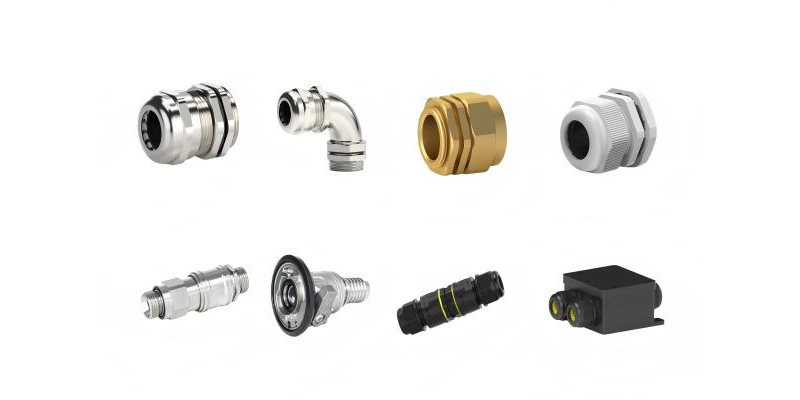
Classification by Compression Structure
Single Compression Cable Glands
Working Principle: Provides basic mechanical fixation and sealing protection by compressing the cable outer sheath through a single sealing mechanism.
Application Scenarios: Unarmored cables, plastic or rubber-sheathed cables, indoor general electrical installations, building power distribution, small equipment control cabinets.
Key Advantages: Easy installation, cost-effective, suitable for conventional scenarios with minimal environmental stress.
Double Compression Cable Glands
Working Principle: Adopts a dual-sealing design that compresses both the cable armor layer and the inner sheath separately, forming two sealing defense lines.
Application Scenarios: Armored cables, power plants, heavy-duty factories, high-vibration environments.
Key Advantages: Enhanced sealing performance, prevents gas migration, provides excellent mechanical retention—making it the preferred choice for industrial environments.
Classification by Material Type
Brass Cable Glands
Material Characteristics: High-quality brass substrate, usually nickel-plated for improved corrosion resistance.
Application Scenarios: General industrial environments, control cabinets, power distribution systems.
Core Advantages: Excellent electrical conductivity, good abrasion resistance, high mechanical strength—the classic industrial cable gland material.
Stainless Steel Cable Glands
Material Grades: Mainly divided into SS304 and SS316L grades.
Application Scenarios: Food processing, pharmaceuticals, marine engineering, chemical corrosion environments, extreme temperature environments.
Core Advantages: Excellent chemical corrosion resistance, high temperature tolerance, the first choice for hygienic applications, meeting FDA standards.
Nylon Cable Glands (Polyamide)
Material Characteristics: Engineering plastic nylon 6 or nylon 66 with UV stabilizers added.
Application Scenarios: Automation equipment, low-voltage control cabinets, HVAC systems, indoor wiring.
Core Advantages: Lightweight, low cost, good insulation performance, UV resistant, easy to install.
Classification by Functional Characteristics
Waterproof Cable Glands
Protection Ratings: IP65, IP66, IP67, IP68 (withstands up to 10 bar water pressure).
Sealing Technology: Multi-sealing ring design, typically using nitrile rubber or silicone materials.
Application Scenarios: Outdoor lighting, outdoor electrical cabinets, underwater equipment, ships, rain-exposed environments.
Explosion-proof Cable Glands
Certification Standards: ATEX, IECEx, Exd IIC Gb explosion-proof certification.
Design Features: Special flameproof structure prevents internal arcs from igniting external explosive gases.
Application Scenarios: Petrochemical, natural gas, coal mines, dust environments and other hazardous areas.
EMC Electromagnetic Shielding Cable Glands
Core Function: Provides 360° electromagnetic shielding, preventing Electromagnetic Interference (EMI) and Radio Frequency Interference (RFI).
Application Scenarios: Precision instruments, communication equipment, medical devices, automation control systems.
Armored Cable Glands
Special Design: Designed specifically for SWA (Steel Wire Armoured) cables, equipped with armor clamping devices.
Main Types: BW type (indoor brass type), CW type (waterproof type).
Application Scenarios: Industrial power transmission, underground laying, heavy-duty cables requiring mechanical protection.
Special Application Types
Flange Type Cable Glands: Precision cast brass, suitable for large-diameter cables and special installation requirements
Marine Cable Glands: Super corrosion resistance, meeting classification society certification standards
Metal Hose Cable Glands: Used with metal corrugated pipes, providing flexible cable protection solutions
Aluminum Alloy Cable Glands: Lightweight and high strength, suitable for rail transit and new energy fields
Hoonsun Professional Cable Gland Product Line
As a professional manufacturer with 20 years of industry experience, Hoonsun (Hongxiang Connector) has established a complete cable gland product matrix covering almost all industrial application scenarios.
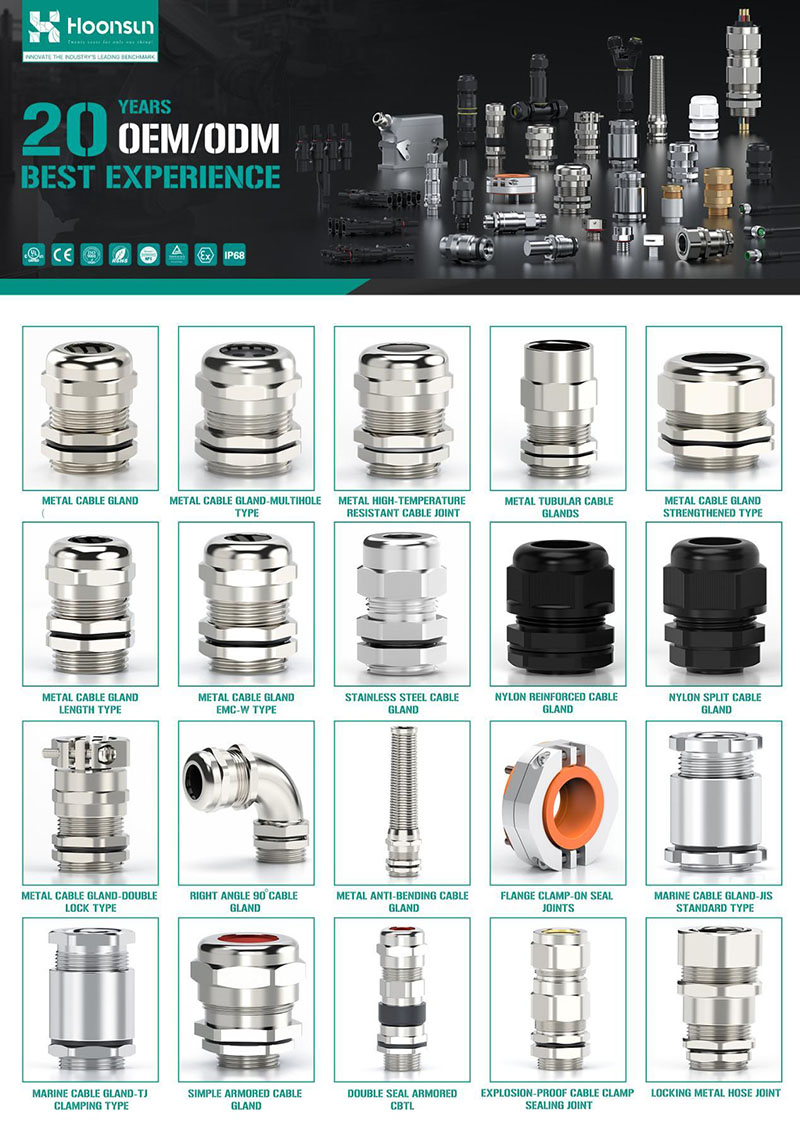
Nylon Cable Gland Series
Hoonsun nylon cable glands strictly follow both PG and Metric standards, offering both standard thread and extended thread options:
Protection Rating: IP68 waterproof and dustproof
Temperature Range: Static -40°C to 100°C
Certifications: CE, RoHS, REACH
Size Range: Full size coverage from M12 to M63
Special Design: Integrated sealing structure, wide clamping range, excellent tensile strength
