

Request A Quote

Stainless Steel Cable Glands Design and Selection Guide

Author    |    hongxiang_admin    |    April 22, 2026
facebook sharing button
twitter sharing button
line sharing button
wechat sharing button
linkedin sharing button
pinterest sharing button
whatsapp sharing button
telegram sharing button
In many industrial systems, cable glands are responsible for sealing, securing, and protecting cable entry points under various operating conditions. In fields such as rail transportation, marine engineering, energy systems, and heavy equipment, the performance of cable glands directly affects the stability and service life of the equipment.

Stainless steel cable glands are widely used in these fields because they can withstand mechanical stress, corrosion, and prolonged humid environments. This article will detail several common types and specifications of stainless steel cable glands, and how to select the appropriate cable gland for different operating conditions.
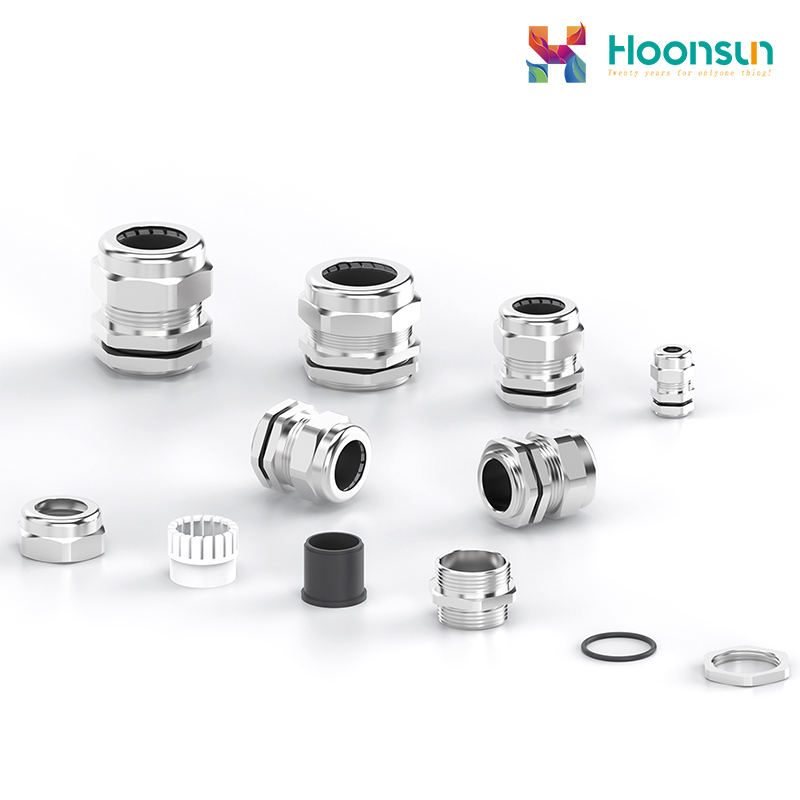
HOONSUN Stainless Steel Product Specification Table

Types of Stainless Steel Cable Glands and Their Uses

In industrial applications, cable glands are expected to perform more than just cable fixing. They need to provide sealing, strain relief, and protection against environmental factors.

Standard Stainless Steel Cable Glands

These are commonly used in control cabinets, distribution boxes, and general equipment. Made from 304 or 316L stainless steel, they provide solid mechanical strength and corrosion resistance. With proper sealing components, they can achieve IP67 or IP68 ratings, making them suitable for outdoor use.

Marine Grade Cable Glands

In offshore and coastal environments, exposure to salt and humidity can quickly degrade standard materials. Cable glands made from 316L stainless steel are more resistant to salt spray and chemical corrosion, which makes them suitable for shipbuilding, offshore wind power, and marine installations.

Explosion-Proof Cable Glands

For oil, gas, and chemical processing plants, cable glands must meet explosion-proof requirements. These designs prevent sparks or heat from escaping into hazardous environments. They also provide sealing and mechanical protection under demanding conditions.

Custom Cable Glands

In some cases, standard sizes or thread types are not suitable. Custom cable glands can be manufactured with specific thread standards, clamping ranges, or structural designs to match equipment requirements.

Material and Protection Specifications

Material choice and sealing performance are key factors when selecting cable glands. The table below shows common specifications used in industrial stainless steel cable glands:

Item Specification
Product Material 304 Stainless Steel / 316L Stainless Steel
Protection Grade IP67 / IP68
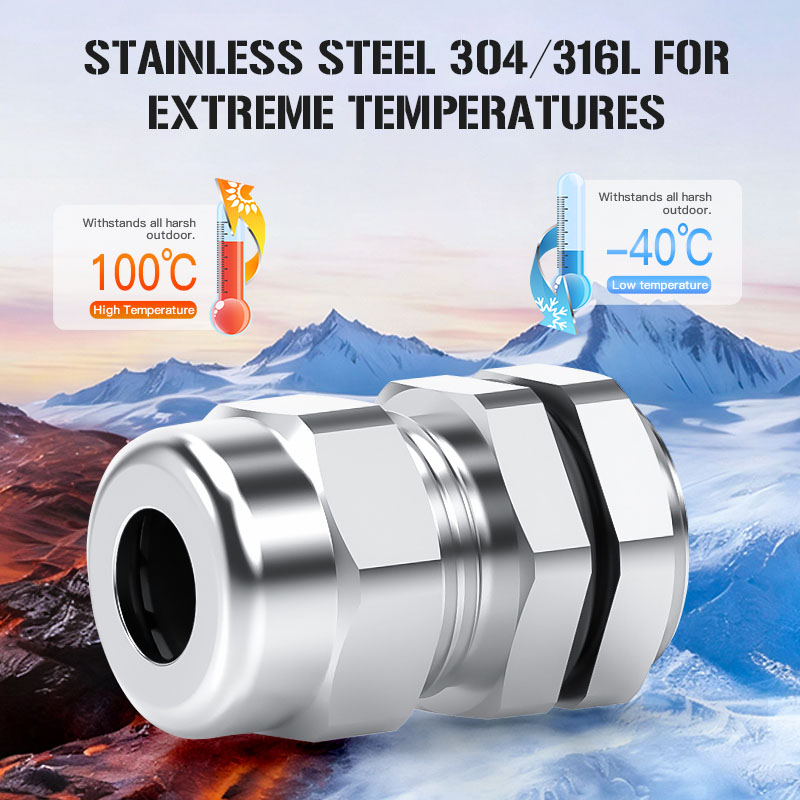
Temperature Range -40°C to +110°C
Sealing Material NBR / Silicone Rubber
Thread Type Metric M / PG / NPT / G
Explosion-Proof Grade Ex d IIC / Ex e II T6 (Optional)
Salt Spray Test 304: Over 480 hours; 316L: Over 1000 hours
Applicable Cables Rubber cables, silicone cables, shielded cables

These specifications show that stainless steel cable glands can be used in both standard environments and more demanding conditions such as marine or chemical applications.

Thread Types and Size Options

Choosing the correct thread type is necessary to ensure compatibility with equipment.
Metric Thread Series (M)

Model Thread Cable Range (mm) Reaming Diameter (mm)
M12 M12×1.5 3 to 7 10.5
M16 M16×1.5 5 to 10 14
M20 M20×1.5 6 to 12 18
M25 M25×1.5 9 to 16 22
M32 M32×1.5 13 to 20 29

PG Thread Series

Model Thread Cable Range (mm) Reaming Diameter (mm)
PG7 PG7 3 to 6 11
PG11 PG11 5 to 10 17
PG16 PG16 8 to 14 23
PG21 PG21 10 to 16 28

NPT Thread Series

Model Thread Cable Range (mm)
NPT1/4 1/4″ NPT 3 to 7
NPT1/2 1/2″ NPT 8 to 14
NPT3/4 3/4″ NPT 12 to 18

Metric threads are widely used in Asia and Europe, while NPT threads are more common in North America. PG threads are often found on European equipment.

Selection Based on Application Environment

Different working conditions require different material and protection levels. The following table can be used as a reference when selecting cable glands:

Application Environment Recommended Material Product Type
General indoor or outdoor 304 Stainless Steel Standard cable glands
High humidity or dust 304 Stainless Steel IP68 waterproof cable glands
Marine and offshore 316L Stainless Steel Corrosion-resistant cable glands
Chemical environments 316L Stainless Steel High corrosion resistance cable glands
Explosive areas 304 or 316L Explosion-proof cable glands
High vibration systems 304 or 316L Anti-vibration cable glands

This type of selection helps ensure stable performance over long operating periods.

Performance Characteristics

Stainless steel cable glands are designed to handle demanding industrial conditions.

Mechanical Strength: The material provides good resistance to deformation and can withstand continuous mechanical load.

Corrosion Resistance: 316L stainless steel performs well in environments with salt, moisture, or chemical exposure.

Sealing Capability: IP67 and IP68 ratings allow cable glands to prevent dust ingress and water penetration, including temporary immersion.

Resistance to Vibration: The clamping structure helps keep cables fixed even when equipment is subject to movement or vibration.

Temperature Range: Cable glands can operate in both low-temperature outdoor environments and higher temperature industrial systems.

Typical Application Areas

Stainless steel cable glands are widely used in:

  • Rail transit and high-speed rail systems
  • New energy vehicles and charging stations
  • Wind and solar power equipment
  • Shipbuilding and marine engineering
  • Oil, gas, and chemical industries
  • Industrial automation and machinery
  • Outdoor lighting systems
  • Water treatment and environmental equipment

In these applications, long-term sealing and mechanical stability are required, often with limited maintenance access.

Installation and Selection Considerations

When selecting and installing cable glands, a few practical points should be considered:

  • Match the thread type with the equipment interface
  • Select sealing materials based on temperature and environment
  • Ensure the cable diameter fits within the clamping range
  • Consider vibration levels in the operating environment
  • Confirm the required protection rating

Careful selection helps avoid installation problems and improves long-term reliability.

HOONSUN Stainless Steel Cable Gland Series

HOONSUN’s stainless steel product line includes stainless steel cable glands, fixed cable glands, explosion-proof cable glands, and custom cable entry solutions. These products are widely used in applications that require waterproofing, dust protection, corrosion resistance, explosion protection, and reliable performance under vibration.

Stainless Steel Cable Glands

Manufactured from 304 or 316L stainless steel, these cable glands offer strong mechanical performance and solid corrosion resistance. They are fitted with high-quality sealing components to achieve IP67 or IP68 protection. Typical applications include outdoor equipment, distribution boxes, machinery, and control cabinets.

316L Marine Grade Stainless Steel Cable Glands

Designed for marine service and other corrosive environments, these cable glands are suitable for ships, offshore wind power systems, and chemical facilities. The 316L stainless steel construction provides good resistance to salt spray, acids, alkalis, and long-term environmental exposure.

Explosion-Proof Stainless Steel Cable Glands

These cable glands are designed for hazardous areas where flammable gas or dust may be present, including oil and gas, chemical processing, natural gas systems, and mining operations. They combine explosion-proof performance with sealing, dust protection, and cable retention.

Custom Stainless Steel Cable Glands

Custom options are available for thread type, body length, clamping range, and special structural requirements. This makes it easier for equipment manufacturers to match specific installation and operating conditions.

Conclusion

Stainless steel cable glands are widely used in industrial systems where durability, sealing, and resistance to environmental factors are required. By selecting suitable materials and configurations, they can provide stable performance in both standard and demanding environments.

Understanding specifications and choosing the right cable gland for each application helps ensure reliable operation and reduces the risk of failure over time.

How Can We Help You?

Our professional team is ready to provide you with prompt and support.

logo

As a trusted cable gland supplier, our connector products serve international markets, including new energy, rail transportation, outdoor lighting, robotics and automation, industrial electrical cable equipment, and computer superservers.

© Copyright 2026 ZHEJIANG HONGXIANG CONNECTOR CO., LTD .

+86-577-62628623