

blog
Metal vs Nylon Cable Glands How to Choose the Right Option?


In industrial and electrical systems, cable connectors, though seemingly small, directly impact sealing, safety, and long-term reliability. The choice between metal and nylon cable connectors depends on actual operating conditions, not personal preference.
At Hoonsun cable gland, both types of cable connectors are widely used across various industries. They look similar and both have an IP68 protection rating, but their material properties determine their advantages and applications. Understanding their differences helps avoid incompatibility and unnecessary costs.
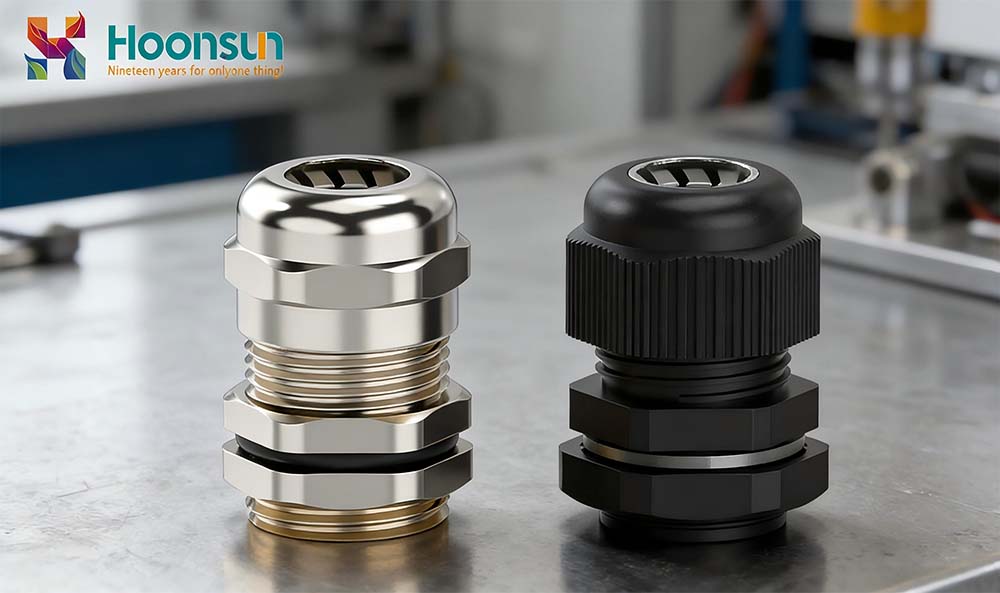
What Sets Metal and Nylon Cable Glands Apart?
Metal cable glands are usually made from nickel-plated brass, while nylon cable glands use PA66 engineering plastic. Both can achieve IP68 sealing, but their behavior changes under different environments.
This basic comparison shows that both options meet sealing requirements, but they serve different technical needs.
| Feature | Metal Cable Gland | Nylon Cable Gland |
| Material | Nickel-plated brass | PA66 nylon |
| Protection Level | IP68 | IP68 |
| Temperature Range | -40°C to 120°C | -40°C to 100°C |
| Strength | High | Moderate |
| Weight | Heavier | Lightweight |
| Conductivity | Conductive | Insulating |
Performance in Real Working Conditions

Mechanical Strength and Durability
Metal cable glands handle higher mechanical stress. They remain stable under vibration, repeated tightening, and long-term use. This makes them suitable for heavy-duty environments.
Nylon cable glands perform well under standard conditions. They offer sufficient strength for most indoor and light industrial applications.
Electrical Behavior and Signal Stability
Metal cable glands provide conductivity and support grounding. They also help reduce electromagnetic interference in sensitive systems.
Nylon cable glands are non-conductive. They are often used where electrical isolation is required, such as control systems or instrumentation.
Environmental and Temperature Resistance
Metal cable glands perform better in high-temperature and outdoor environments. They maintain structure and sealing performance over time.
Nylon cable glands resist moisture, oils, and mild chemicals. They are widely used in environments where corrosion resistance matters but extreme heat is not present.
Installation and Weight Considerations
Nylon cable glands are easier to handle due to their lighter weight. They are often chosen for projects that require quick installation or large quantities.
Metal cable glands require more effort during installation but provide a stronger and more rigid connection.
Application-Based Selection Guide
Choosing the right cable gland becomes much clearer when you look at the actual working environment instead of only comparing specifications. Different industries and setups place different demands on sealing, strength, electrical behavior, and long-term durability.
In real projects, engineers usually start from the application scenario and then narrow down the material choice. For example, equipment exposed to vibration, heat, or outdoor conditions often requires stronger mechanical performance and stability. In contrast, systems focused on signal transmission or compact design may benefit more from insulation and lightweight components.
Another factor to consider is maintenance and lifecycle expectations. In installations where access is limited or downtime is costly, a more durable material can reduce replacement frequency. On the other hand, for standard installations or large-scale deployments, ease of installation and cost control may carry more weight.
It is also worth noting that no single cable gland type fits every situation. The same project may even use both metal and nylon cable glands in different sections, depending on functional requirements.
By aligning the selection with the actual application rather than relying on general assumptions, you can achieve better performance, longer service life, and a more efficient overall system design.
| Application | Recommended Type |
| Heavy machinery and vibration environments | Metal |
| Power systems and grounding applications | Metal |
| Outdoor installations with long exposure | Metal |
| Control panels and automation systems | Nylon |
| Electronics and signal equipment | Nylon |
| Food processing and humid environments | Nylon |
| Large-scale projects with budget limits | Nylon |
Cost and Project Planning
Nylon cable glands are more cost-efficient, especially in large-volume projects. Their lower material and production cost make them suitable for general-purpose applications.
Metal cable glands have a higher initial cost, but they offer longer service life in demanding environments. In systems where downtime is costly, this can be a practical trade-off.

Conclusion
Metal and nylon cable glands are designed for different environments and system requirements. The right choice depends on how the equipment is used, not just on specifications.
If your project involves demanding conditions such as vibration, heat, or electrical grounding, metal cable glands provide a stable solution. If your focus is insulation, corrosion resistance, and efficient installation, nylon cable glands are a practical option.
At Hoonsun, selecting the right cable gland ensures reliable connections and consistent system performance over time.
FAQs
Q1: Both metal and nylon glands achieve IP68. Is the waterproof performance exactly the same?
A: Yes, both can pass IP68 tests under factory conditions. However, long-term waterproof reliability depends on material aging: metal glands retain seal life better under high temperature and UV exposure, nylon glands are equally stable in standard environments, but for long-term outdoor use we recommend UV-stabilized PA66.
Q2: Will metal glands rust?
A: Hoonsun metal glands use H62 brass with precision nickel plating, offering strong salt spray and oxidation resistance. However, if the plating is severely scratched or the gland is exposed to strong acids/alkalis for long periods, the brass may still discolor. For extreme corrosive environments, consider stainless steel glands or nylon glands.
Q3: Can nylon glands be used outdoors?
A: Yes. PA66 has good weather resistance with an operating range of -40°C to 100°C, covering most outdoor environments. However, long-term strong UV exposure can cause material aging. For outdoor use, we recommend UV-stabilized nylon glands.
Q4: When must I choose a metal gland?
A: A metal gland is strongly recommended if any of the following conditions apply:
- The equipment requires grounding
- There is EMI concern or EMC shielding is needed
- Ambient temperature continuously exceeds 100°C
- The equipment experiences strong vibration or shock
- Explosion-proof certification (ATEX) is required.
Q5: Can nylon glands replace metal glands in hazardous areas?
A: No. Explosion-proof areas must use certified metal cable glands. Nylon glands are not explosion-proof and must never be used as a substitute.
Q6: How do I select the correct thread size?
A: Hoonsun standard glands are available in metric (M), NPT, PG, G and other thread standards. When selecting, confirm the equipment’s mounting hole thread and the cable outer diameter range. You may also provide drawings and let our technical team assist with matching.
Q7: What is the approximate price difference between the two types?
A: For the same specification, nylon glands typically cost 1/3 to 1/2 of metal glands. The exact difference depends on size and order quantity. Please contact Hoonsun sales for a real-time quote.
Q8: Can you produce non-standard colors or lengths?
A: Yes. Hoonsun supports customization based on drawings or samples, including special plating for metal glands, custom colors for nylon glands, and extended thread lengths. Contact our sales team for details.
How Can We Help You?
Our professional team is ready to provide you with prompt and support.

As a trusted cable gland supplier, our connector products serve international markets, including new energy, rail transportation, outdoor lighting, robotics and automation, industrial electrical cable equipment, and computer superservers.
© Copyright 2026 ZHEJIANG HONGXIANG CONNECTOR CO., LTD .