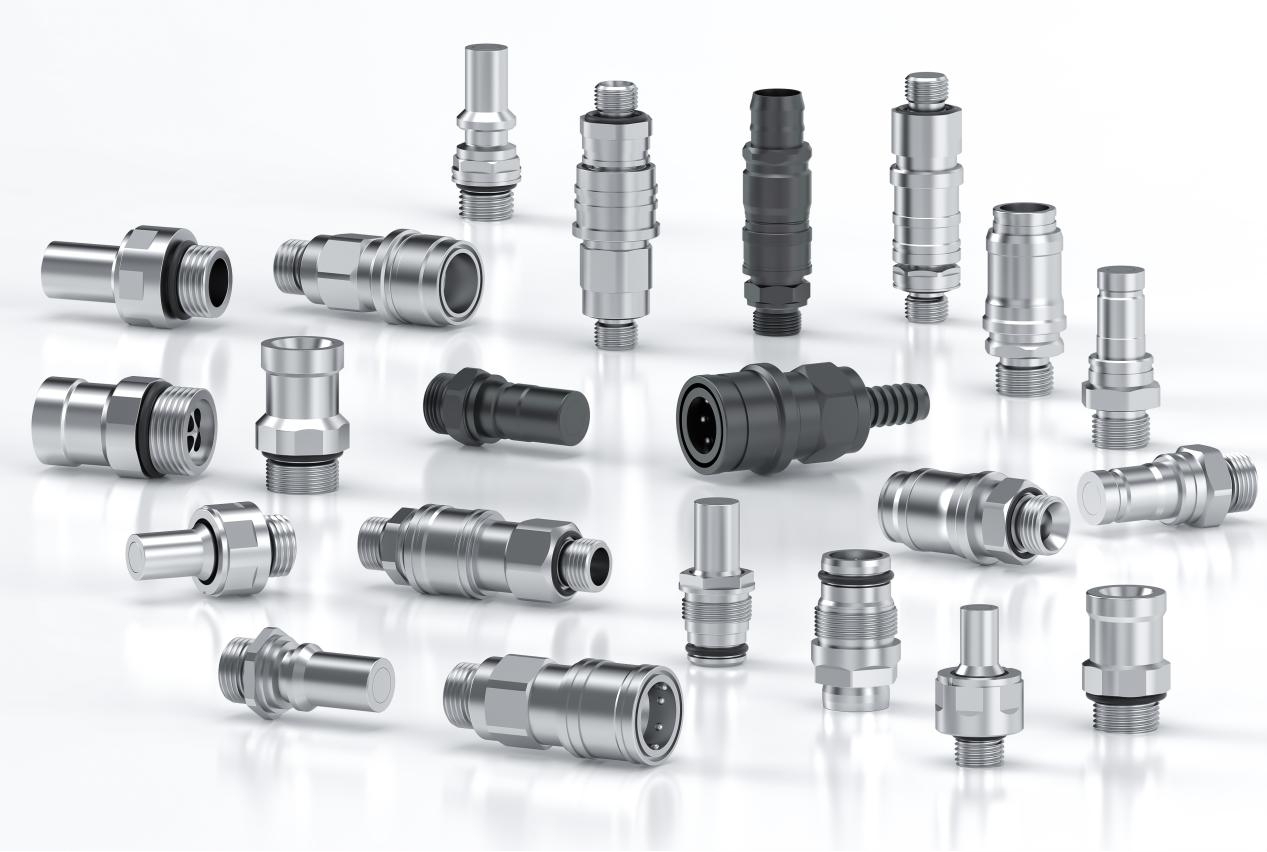
While all components are important, connectors are often the “hidden link.” They are inconspicuous but crucial components that ensure the reliable and safe operation of the entire liquid cooling system.
Why Liquid Cooling Connectors Are Critical?
Ensuring Leak-Free, Reliable Coolant Circulation
In liquid-cooled data centers, connectors are continuously exposed to environments involving coolant flow, pressure changes, and temperature cycling. Poorly designed or low-quality connectors can leak, corrode, or fail, leading to coolant loss, damage to expensive electronic equipment, and unplanned downtime.
Furthermore, many modern connectors are designed to support “quick disconnect” (QD) operations: they can be quickly connected or disconnected, usually without draining the cooling loop, and with minimal or no coolant leakage. This is especially useful for maintenance, upgrades, or emergency equipment replacement.
High Flow, Low Pressure Drop & Thermal Efficiency
AI server racks require high-flow coolant to dissipate large amounts of heat. Connectors must ensure smooth and efficient coolant flow while minimizing turbulence and pressure loss.
The design typically utilizes large-diameter connections and manifolds to evenly distribute the coolant to multiple servers.
Durability Under Harsh Conditions
Data centers are not always clean and dust-free environments. Connectors may experience vibration, pressure fluctuations, temperature changes, and even occasional mechanical stress during maintenance. Furthermore, the composition of the coolant and potential exposure to oxygen or contaminants can cause connectors to corrode or chemically degrade over time.
Therefore, high-quality connectors must be made from corrosion-resistant, durable materials and carefully designed to ensure long lifespan, reliable sealing performance, and resistance to mechanical or environmental stresses.
Enabling Modularity, Maintenance & Scalability
With hardware upgrades, server replacements, or rack expansions, data centers often need to reconfigure their cooling circuits. Thanks to carefully designed liquid cooling connectors, modules can be replaced or reconnected without draining the entire system. This modular design simplifies maintenance and improves future scalability.
Connectors are not auxiliary components, but rather key elements in building flexible, easy-to-maintain, and scalable liquid-cooled data centers.
Key Features of a High-Quality Liquid-Cooling Connector
Addressing the demands of modern AI-driven data centers, not all connectors perform equally. When selecting connectors for liquid cooling systems, the following are key characteristics that differentiate good connectors from exceptional ones:
Leak-Proof, Dry-Break or Quick-Disconnect Design
The connectors should provide a reliable, redundant seal to prevent leaks. The quick-disconnect (QD) feature is very important: it allows modules or racks to be isolated, maintained, or replaced without draining the entire cooling circuit or causing liquid spills..
High Flow Capacity with Low Pressure Drop
The inner diameter should be large enough to accommodate the required flow rate. The design should minimize fluid turbulence and pressure loss to ensure effective coolant circulation and heat dissipation.
Corrosion Resistance & Material Integrity
Use corrosion-resistant metals or alloys and ensure their compatibility with the chemical composition of the coolant. Ensure that all components in contact with the coolant (cold plates, manifolds, connectors) are made of compatible materials to avoid galvanic corrosion.
Robust Mechanical Design & Long-Term Reliability
Connectors should withstand vibration, thermal cycling, pressure fluctuations, and mechanical stress from maintenance operations. Service life should be long (many years) to support continuous operation without degradation or performance issues.
Modularity, Ease of Installation & Maintenance
- Connectors should facilitate modular designenable rapid assembly, disassembly, and reconfiguration.
- They should integrate easily with existing CDUs, manifolds, and piping.
- Maintenance operations (e.g., replacement, leak checking) should be simple, quick, and safe.
Compliance and Industry-Standard Compatibility
- Compatible with standard rack-mounted manifolds, coolant distribution units, and data center piping architectures.
- Supports multiple coolant types for increased flexibility.
Connectors that meet these standards are not only convenient and easy to use, but also fundamental to ensuring reliability, performance, and scalability.
How High-Performance Connectors Help Unlock the Potential of Liquid Cooling
When building liquid cooling infrastructure with compliant, high-quality connectors, data centers gain several key advantages:
Stable, maintenance-free operation: Thanks to leak-proof, corrosion-resistant, and durable connectors, cooling systems can operate continuously for years, minimizing the risk of liquid leaks or unexpected failures.
Scalability and flexibility: Modular connectors allow data centers to expand racks, upgrade servers, or reconfigure cooling loops without interrupting operations or requiring complex modifications.
Efficient heat dissipation performance: High flow rates and low resistance maximize coolant delivery and heat dissipation efficiency. This is crucial for handling the high heat loads generated by AI processors.
Reduced operating costs: Quick-connect connectors simplify maintenance procedures, reduce upgrade risks, and lower costs throughout the system’s lifecycle.
Enhanced sustainability: Efficient liquid cooling systems reduce reliance on energy-intensive air conditioning, lower energy consumption, and support more environmentally friendly data center operations.
What Makes Our Liquid-Cooling Connectors Stand Out?